Where is the cargo right now?
Customers and managers call drivers to ask about location and arrival time. Every call distracts the driver, and the answer is out of date a few minutes later.
OXIOS provides logistics software development for freight forwarders, carriers and delivery businesses. We build apps that show where the cargo is, keep orders and documents in one place and replace endless calls with carriers: mobile apps for drivers and couriers, web dashboards for dispatchers, and the APIs that connect them.
Customers and managers call drivers to ask about location and arrival time. Every call distracts the driver, and the answer is out of date a few minutes later.
Waybills, invoices, photos of delivered goods and signed acts live in different chats and inboxes. Finding the right file for an invoice or a dispute can take hours.
Orders, changes and confirmations go through phone calls and personal messengers, so nobody has the full history when something goes wrong.
Drivers pass through areas with weak signal, phones run out of battery and GPS drifts. Software that expects a stable connection loses data exactly where you need it most.
Live location of vehicles and shipments on a map, with statuses, movement history and a clear indicator of how fresh each position is.
Orders with statuses, attached documents and photos, search and export, so every waybill and act is linked to the shipment it belongs to.
A conversation attached to each order, with push notifications, so changes and confirmations are recorded next to the shipment instead of in personal messengers.
Assigned jobs, routes, status updates and proof-of-delivery photos in an iOS and Android app that keeps working with poor signal and syncs later.
A web panel to create orders, assign carriers, watch the map, manage users and roles, and see which shipments need attention.
Connections to accounting or ERP systems, maps, SMS and customer portals through a Node.js API documented in Swagger/OpenAPI.
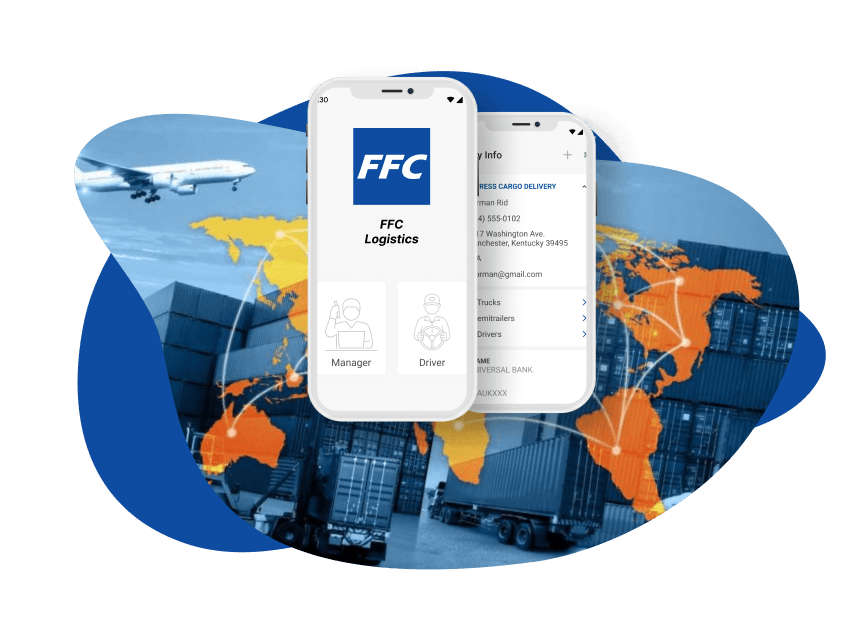
A freight transport app with real-time cargo tracking, order and document management and carrier chat.
Open case study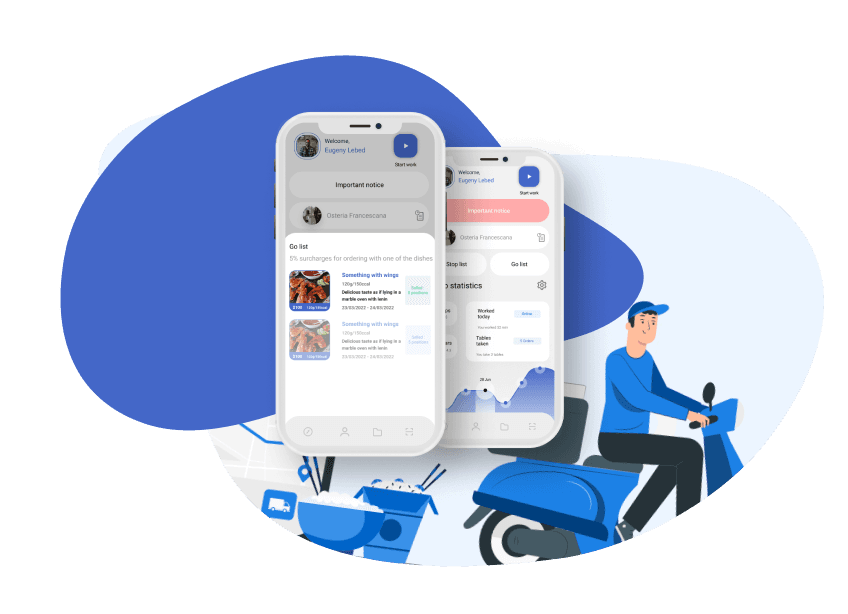
Digital menus, QR ordering, card payments and delivery tracking — plus tools for waiters and couriers.
Open case study
A child-safety app for GPS watches: location, geofences, voice chat and movement history.
Open case studyLogistics software development starts with the questions people ask each other every day: where is the truck, has the cargo arrived, where is the signed document? In FFC Logistics we answered them with one freight app: real-time GPS cargo tracking, order and document management, and chat with carriers. Instead of calling the driver, a manager opens the order and sees the location, the status and the whole conversation in one place.
GPS is harder than a pin on a map. Phones and trackers report positions at different intervals, lose signal and drain the battery if you ask for updates too often. We worked through these trade-offs on GoGPS.ME, a parent app for kids' GPS watches with live location, geofences and movement history. The same thinking applies to a fleet: choose the update rate for each use case, buffer data on the device while offline and send it when the connection returns, and always show the user how old a position is.
Last-mile delivery adds couriers. In the QuickPay restaurant system, the staff app gives couriers their orders and routes, while guests follow the delivery status. For transportation companies the same pattern becomes a driver app with assigned jobs, proof-of-delivery photos and status updates that survive weak signal. Behind every app sits an API backend in Node.js with role-based access for dispatchers, carriers and customers, documented so your existing systems can connect to it.
We usually start with the most painful flow — often tracking plus documents for one type of shipment — and release it to a small group of drivers before a full rollout. Discovery maps your current tools, data and integrations, and you see working software at the demo after each two-week sprint. The free estimate covers scope, timeline, team shape, budget range and risks. Describe your operations and we'll reply within one business day.
As of 2026, an MVP with a driver app, GPS tracking, orders and a dispatcher panel typically costs approximately $40,000–$90,000. Platforms with customer portals, complex pricing rules and several integrations with accounting or ERP systems cost more. The main factors are the number of user roles, integrations, offline requirements and how much real-time data you process. Our free estimate gives a range for your scope.
If your processes are standard, an off-the-shelf transport management system is usually faster and cheaper. Custom software pays off when your workflow is part of your advantage, when you need a branded app for customers or drivers, or when you are stitching several tools together. A common middle path is to keep your existing system and build an app or portal that connects to it through its API.
Outdoors with a clear sky view, a phone typically reports position within a few metres; in dense city centres, tunnels and warehouses accuracy drops noticeably. More frequent updates improve the picture but cost battery and mobile data. We pick the update rate for each scenario, filter obvious jumps on the server and show when each position was recorded, so dispatchers know what they are looking at.
Yes, if it is designed for it from the start. We store status changes, photos and signatures on the device, queue them while there is no signal and upload them when the connection returns. The server resolves conflicts, for example when a dispatcher changed an order while the driver was offline, and the app always shows what has not been synced yet.
If the system has an API, webhooks or at least a reliable export format, yes. During discovery we review its documentation and test access before committing to a timeline. We document our own API in Swagger/OpenAPI, so your IT team or other vendors can connect additional tools later without depending on us for every change.
iOS and Android apps on React Native and Expo: design, backend, App Store and Google Play release, push, subscriptions and support after launch.
Learn moreREST APIs and Node.js backends for web and mobile apps: auth, payments, push, maps, Telegram bots, CRM integrations and scheduled jobs.
Learn moreCustom web applications, SaaS platforms, marketplaces and admin panels on React, Next.js and Node.js, from discovery to launch and support.
Learn moreTell us what you want to build. Within one business day we reply with a recommended scope, rough timeline, team shape and budget range.